2026 10月30日 13:49
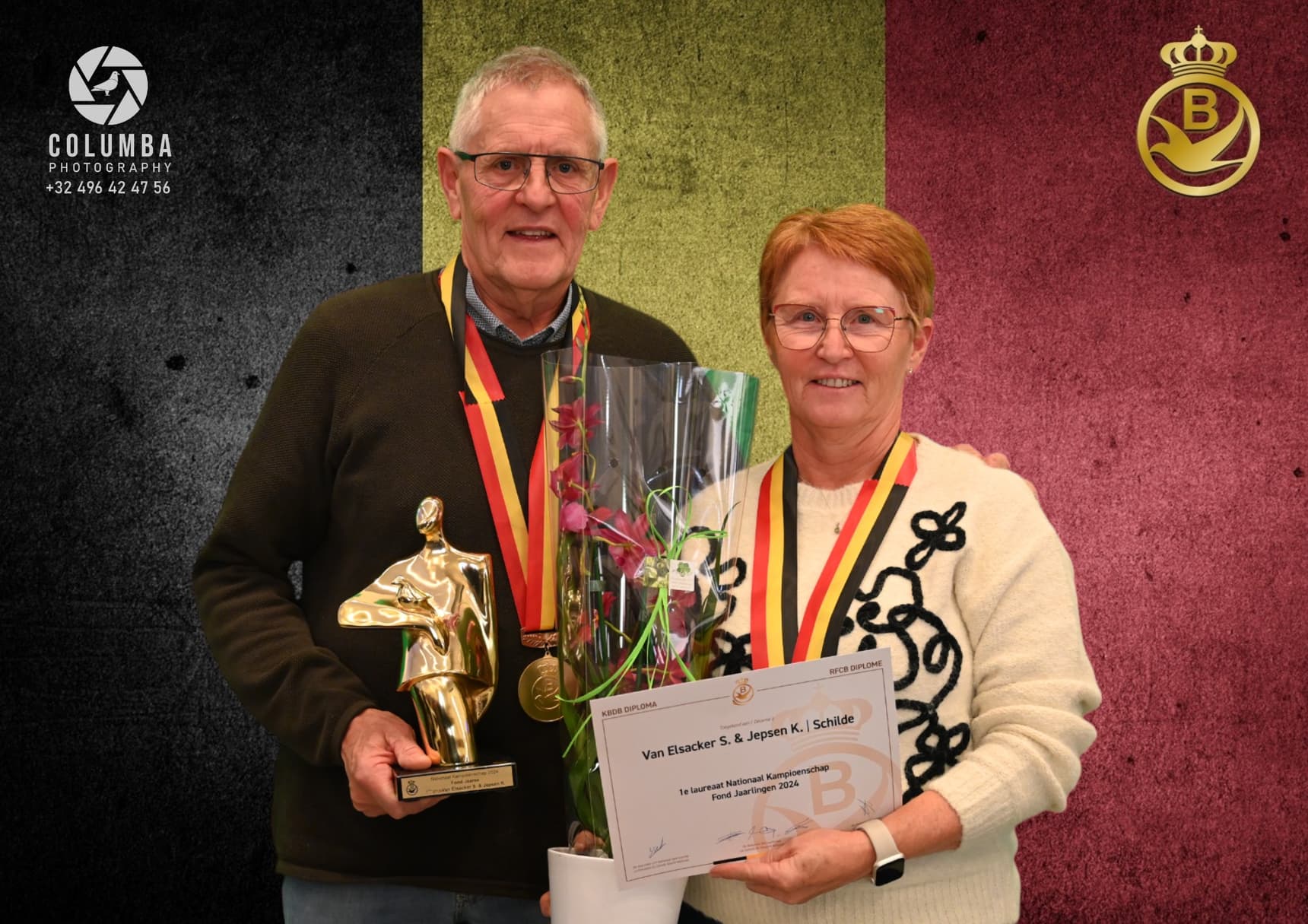
van elsacker-jepsen (schilde) crowned 1st, 3rd and 4th national kbdb champion over the last three seasons
Schilde: The exceptional quality of the Van Elsacker-Jepsen pigeons has known no limits for decades. When you realise that Serge was already crowned "King" of Union Antwerp (the most iconic middle-distance federation of all time) back in 1986, that tells you everything you need to know.Serge simply has pigeon racing in his blood, and born champions like him can never be kept down for long. Even when they experience a less successful season, they always bounce back. Renewed courage, determination and motivation bring them right back where they belong: at the very top of Belgian pigeon racing.
In 2024, Serge and his wife Kirsten were crowned 1st National KBDB Champion Long Distance Yearlings. The season following a national championship victory is always a test. Will the pigeons perform at the same exceptional level again? But a master fancier like Serge always knows how to get his team ready for the challenge. And look what happened… once again, they stepped onto the podium at the national championship celebrations, this time as 3rd National KBDB Champion Extreme Long Distance Yearlings!
And then came the 2026 season… Would they confirm their outstanding performances once again? Absolutely! This time, they narrowly missed out on a podium finish, but with the title of 4th National KBDB Champion Long Distance Yearlings 2026, there is nothing but satisfaction and smiling faces in Schilde. On top of that, they can proudly frame another prestigious diploma: 13th National Overall KBDB Champion 2026! Easier said than done, of course, and yet another confirmation that the Van Elsacker-Jepsen pigeons are made of the right stuff!
And while we're talking about championships, here are a few more outstanding achievements:
- 1st King (Overall Champion) Middle Distance, Long Distance and Extreme Long Distance – Old Birds, Yearlings and Youngsters – Kempische Fondclub (137 members)
- 4th Provincial KBDB Champion Long Distance Antwerp
And for those who love admiring outstanding race results, sit back and enjoy:
2.05.26 Melun 549 oude
3,6,8,9,13,13,17,17,18,22,23,24,26,27,28,………..
363 jl.
5,7,11,11,15,16,20,21,23,24,28,29,……….
09.05.26 TOURY
624 Oude
3,5,8,15,18,23,25,27,27,33,34,………
393 Jl
2,9,12,16,18,24,25,…………
16.05.26. TOURY
404 Oude
2,3,8,9,10,14,15,19,21,22,………….
303 jl
1,4,5,7,9,10,14,16,17,20,……….
23.05.26 TOURY
126 jl
1,15,
4.07.26 Melun
172 oude
1,2,5,6,13,17,……
132 jl
1,2,3,4,11,14,………..
11.07.26 Melun
180 Oude
1,2,3,4,6,8,10,11,14,15,16,17,18,………
139 jl
1,2,3,4,5,6,8,9,11,13,14,………..
18.07.26 Melun
227 jo
2,3,5,7,9,12,15,…………..
25.07.26 Melun
90 oude
1,2,3,5,6,…….
74 jl
1,2,3,4,5,……….
8.08.26 Melun
518 Jo
5,8,11,12,13,14,17,18,26,27,30,……..
23.08.26.TOURY
305 Jo
2,3,4,7,9,11,12,15,16,19,……..
1.07.26 Limoges
299 jl Kfc
2,10,11,15,17,18,19,21,23,…….
15.07.26 Perigieux
115 jl Kfc
1,3,6,7,9,10,11,.’’’
542 jl prov.
1,10,21,29,39,45,47,……….
22.07.26 Aurillac
88 jl Kfc
2,3,6,.’’
59 oude Kfc
1,2,
Nat (z): jl 4,6,28
Nat.3516 jl 12,45,136
18.07.26 Tours
105 oude Kfc
1,5,
290 jl Kfc
2,4,7,9,10
18.04.26 Noyon Brecht
1081 jl
1,2,3,15,19,22,30,
1883 oude
2,3,6,30,32,37,41,42,59,……..
30.08.26 Noyon Brecht
897 Jo
1,4,19,25,26,28,29,30,31,34,37,40……
And – just to mention it in passing – more than 60 provincial victories adorn their impressive list of achievements! In 2026, another provincial victory was secured from Périgueux. Last year, it was the outstanding hens “Kaitlin” and “The Last One” that saw their ring numbers appear at the very top of the provincial results.
The exceptional hen “The Last One” simply couldn't resist adding another magnificent achievement to her record, winning 1st Provincial, 1st National Zone and 2nd National Tulle! Her name certainly suggests a special story, and indeed it does! She is the very last daughter of “Bamiske”, the dam of the 3rd National Ace Pigeon KBDB Great Middle Distance 2017. A true “winning family”… and “The Last One” certainly has every reason to be proud of her own impressive racing record. Take a moment to admire her achievements:
The strength of the Van Elsacker-Jepsen pigeons lies in their ability to produce top-class pigeons in multiple generations. Take hen "Beyonce" for example. She is the grandmother of "Esprit," and "Esprit" is in turn the grandmother of "Ida." It must be a real treat for a fancier to have such a strong breeding line at their disposal.
Also the breeding value of "Elimar" knows no limit. He is father to "Holly", "Haily" and "Katie"
Total widowhood for years
For 30 years now, the “total widowhood” card has been played here. Serge: "It may not be the best system, but you have to keep a lot fewer pigeons that are not motivated and do nothing. That's why we made this choice. The pigeons are transferred to their new loft very late, the future yearlings remain in the young bird loft for a long time and are not paired until March 20. The pigeons return outside for the first time on March 1, due to many problems with birds of prey. When the first pair breeds 16 to 17 eggs, everything is removed and widowhood is a fact. They sometimes fly their first race while still on eggs or just off eggs, but when they return home, everything has been removed anyway.
In 2026, they flew Quievrain on Wednesday and Noyon on Sunday. When they returned from Noyon, I had cleared everything away.
Training is not the biggest time investment here; the cocks are trained when I pair them and the hens during breeding. But that is a maximum of 4 to 5 times that I take them away, and then they have to be ready.
If you experience losses or injured pigeons during the season, you naturally have to look for new pairings, but such things revitalize the team and provide renewed motivation. If I notice that there are some top pigeons among them, I will definitely keep their partners at home. I don't want the loss of a pigeon to also sap the motivation of a top pigeon.
How are your pigeons during the week?
The cocks are at the front of the loft, all the cocks are half-boxed, and their nest bowl remains in the enclosed part of the nest box. The hens are at the back of the loft and get little sunlight. The back of the loft is shielded with plexiglass, which puts the pigeons in a chilly space. The solution for my loft is to run a heating system that maintains more or less the same temperature, which helps the pigeons get in shape. During our visit, we were allowed to feel the lofts, and it was indeed very pleasant there. They are housed in spacious aviaries where they can be let out through a corridor. During training, the widowers are briefly moved to the back of the loft in a separate aviary, while the hens enter the cocks' loft. From there, they are quickly led through the corridor to the back of the loft and back into the aviary, where they spend almost the entire day.
The pigeons train here once a day, and this training is certainly not intensive. Initially, they often encounter birds of prey, which causes them considerable stress. This, of course, is not conducive to flying.
So how do you handle basketing?
The hens then return to the cocks' lofts via the corridor and fly into their nest boxes. These are then completely open, and the pairs are free to do as they please. Once everything is together, I start putting them in the basket, usually starting with my first nominated pigeon to ensure they're properly placed. The first pigeons are only together for a few minutes, and the last for 20 to 25 minutes, but even here, I don't attach much importance. When they return, the pigeons are only allowed in the corridor. When most of the basketed pigeons are home, I go to the lofts and leave them in their nest boxes. Personally, I think this is a good system because otherwise there would be too much chaos and fighting, and the pigeons would become demotivated because there wasn't a partner home. If I leave them in the corridor now and the partner comes home 5 minutes later, there's no problem. The pigeons are allowed to stay together for 2 to 3 hours initially, but after the national races, this usually lasts until the following morning. Only when a race goes very poorly do I quickly separate them, to promote recovery since they're of no use to each other. I do leave them together for half a day on Sunday morning. The hens are basketed every week. If they've completed a race with multiple nights in the basket, they're sent to a shorter, sprint race the following week. For pigeons that have a long-distance race under their belts, I'll observe how the races went to determine what I'll race the following week. You can't decide that in advance. The pigeons are raced on widowhood until early August, after which they're released. They're no longer driven during the week during the season.
Young Pigeons
The young pigeons are divided into three groups and are placed in a large aviary for the first six weeks of their outdoor season to protect them from birds of prey. Afterward, they are separated by round and allowed outside once a day. The first round is darkened until June 1st, the second until June 15th, and the third round until June 21st. The goal is for them to fly at least one, and preferably two, national races. But of course, everything has to go smoothly; you can't always control these things. After the first group has flown Noyon, they are separated. When the third group has also flown Noyon, all the cocks (young and old) from all lofts train simultaneously during the week. The same applies to the hens. It's noticeable that the older pigeons come down faster, but generally speaking, they train much better than if they were trained separately.
Feeding
I always feed the older pigeons twice a day for 30 minutes at a time. They can eat whatever they want, and then I clean everything up. After training, they get a portion of treats and peanuts. The young pigeons only get fed once a day, and a treat mix in the morning. I don't overfeed my pigeons; they simply get a good Vanrobaeys racing mix every day. Upon returning home, they mainly get grit, Tovo, and minerals to pick up first, and BT Amin from Röhnfried or Nano Tolyamin in their drinking water. I haven't added anything to the feed for the past five years, and the pigeons eat just fine. During breeding season, the pigeons get a 7-day treatment with Trichomoniasis in the spring, and during the season, they are only treated as recommended by Herbots Raf. All pigeons are given a treatment against paratyphoid in the autumn without vaccination, the old and yearling pigeons are vaccinated with Colombopox in the spring and the pigeons are given Rota-Paramyxo and Colombopox.
Serge has selected 10 top birds from the very best of his colony especially for the Pigeon Bids online auction.
A fantastic opportunity to strengthen your breeding loft.
This online sale ends Tuesday, November 3rd at 2:00 PM.